How Businesses Adapt to the Age of AI
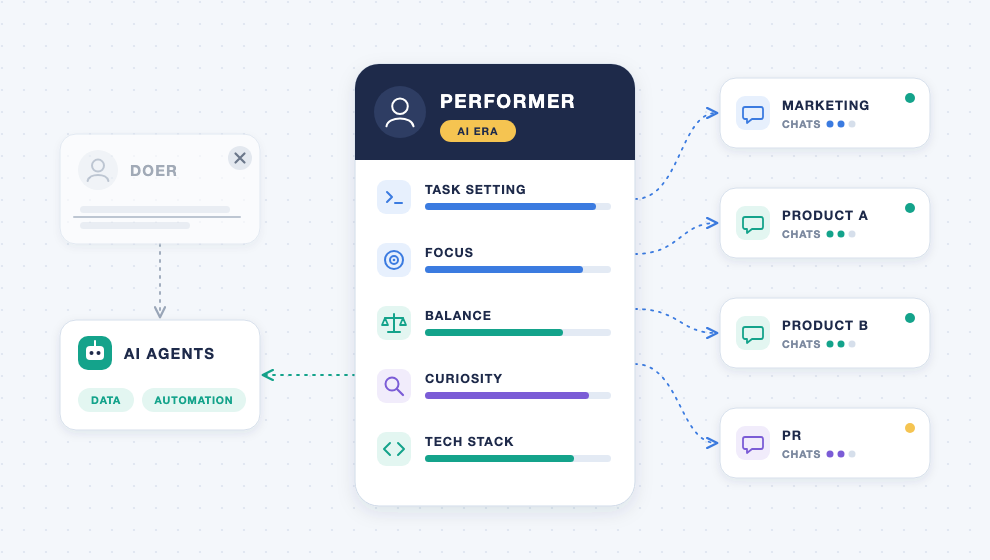
I don’t think there’s any point anymore in discussing small things like how AI speeds up the work of doers. That’s boring and obvious. What’s far more interesting is which people a business needs now, and how its processes should be built.
I separate two types of people here. A doer is someone who does what they’re told. A performer is someone who takes a task, drives it to a result, and owns that result. For performers, AI has become an enormous amplifier. For doers, the picture is much bleaker.
Doers are no longer needed
My first point: businesses no longer need doers. The exception is physical work, where buying a robot is still expensive. There, doers will probably keep winning for another couple of years.
But when it comes to computer-based work, there’s no industry left that needs a doer. Even accountants, lawyers, and general practitioners are exactly the professions that big data replaces first. They will keep their jobs for exactly as long as government regulation protects them. The moment regulation can no longer hold those jobs in place, it’s over for them. I wrote separately about what happens to society once AI replaces work.
Knowing how to set a task
My second point is the ability to set a task properly. You used to be able to set a task badly. Among doers there was even a popular attitude: don’t start until they ask you a second time. Why? Because work moved slowly. You set a task, realized along the way that something was off, went back to clarify how it really needed to be done, and your rank-and-file staff would say: “See, we didn’t even need to start.”
With AI it’s different. If you set the task wrong, you’ll have a wrong result in five minutes. But you will have a result. That’s why being able to say exactly what you want has become a critical skill.
Attention and focus
My third point is about how much attention and focus you have. If you’re simply an employee with one task a day, you’re fine: AI has freed up 90% of your time for personal things.
But if you’re a business owner or a senior executive willing to take on as many tasks as your time allows, then the amount of attention you have decides how many chats you can run at once. In professional work these aren’t just chats, they’re chats inside projects. In Claude or Codex you might have one project for marketing, another for building one product, a third for building another, and a separate one for PR or some research. And each project has a pile of chats.
The more attention you have, the more parallel workstreams you can hold. You set a task in one chat, answer its questions, switch to the next one, answer its questions too, and keep going around the loop.
Peace of mind
As a consequence, the ability to stay mentally balanced becomes essential. I thought this was just me, but now I look at the people I consider truly effective and I can see some of them starting to come unhinged. At that speed of switching, it’s important to plan your tasks properly, keep constant track of what stage each project is at, and keep developing your personal qualities so you can handle more and more information. Once a person stops doing that, their willpower runs out and they simply start to crack.
Looking for the new
Beyond being a performer, it matters a lot whether a person knows how to look for new things or is locked into the approaches they already know.
Why does this matter now? In my own company I’m still amazed when I see someone doing work by hand simply because they didn’t know how to apply AI to it. I look at it, put my head in my hands, explain how AI can change the whole approach, and the work starts moving faster.
So being a performer isn’t enough on its own. A person also has to understand more than their own field. We work with AI and we work on computers, and if you don’t understand the technology you use, you’ve already lost.
It’s like being given a race car without knowing how to shift gears manually. You drive in automatic, at exactly the speed and responsiveness the gearbox allows. But in a race everyone switches to manual. Why? Because you need to accelerate by shifting differently, and brake with the engine instead of burning through the brake pads. If you can’t do that, you’ve lost the race.
It’s the same here. AI seems to have an answer for everything. But if you don’t know how to connect AI to the right tool, how to process data, how to store it, you’ve lost to those who do. That’s why the ability to look wider and ask questions is now irreplaceable too. When I look at my employees, the ones focused on doing things the way they’re used to are the ones whose place in my company is in question.
Processes for AI, not AI for processes
That last point leads to one more conclusion. The real use of AI isn’t adapting AI to your existing business processes. If your processes are built around people, AI can speed something up, but only slightly. If you completely remove the processes that were written for people and rebuild them for AI from scratch, that’s when AI can really show what it can do. But again, you have to understand what AI is capable of and how to connect it to other tools – the whole technical foundation.
And then the people who simply aren’t needed drop out of the process. One example: we had an accountant with an enormous salary. We let several people go, and I still don’t understand why we needed him. We had people pulling data from different systems and saving things by hand. We had a pile of useless Google Sheets. We took AI and built a system that pulls the data from everywhere on its own and produces the financial reports on its own. There’s simply no place for a person in that process.
If we had tried to adapt AI to a process where accountants copy numbers by hand, what would we have sped up? Nothing.
Who checks the result
Rebuilding a process for AI isn’t the whole story, though. AI produces results very quickly, and it can produce mistakes just as quickly. In financial reporting, a wrong number costs real money. There are fewer people in the new process, but responsibility doesn’t go anywhere: someone has to check the result and own it. Instead of an accountant copying numbers by hand, you need a person who builds checkpoints and feedback loops so the system can find and fix its own mistakes. I wrote about this in detail in why the feedback loop matters more than orchestration.
Access and security
When an AI system pulls data from every system in the company on its own, the next question is what it has access to and who controls that. Access to the bank, the accounting system, and the CRM used to belong to specific people, and it was clear who was responsible for what. Now an agent gets that access, and if it’s set up carelessly, a single mistake or a single attack can hit everything at once. So when you rebuild processes for AI, you have to decide from the very start what rights each agent has, where a human has to approve, and how all of it is tracked. More on this in my piece on AI security threats.
Company knowledge as an asset
And one last thing. AI works exactly as well as the company’s context and rules are written down. That knowledge used to live in employees’ heads: when a person left, the knowledge left with them. Now it has to go into a knowledge base that agents read. Then the process doesn’t depend on who’s at work today, and every improvement stays with the company. I explained how to set this up in how to make AI use your knowledge base.