The Future After AI Replaces Work
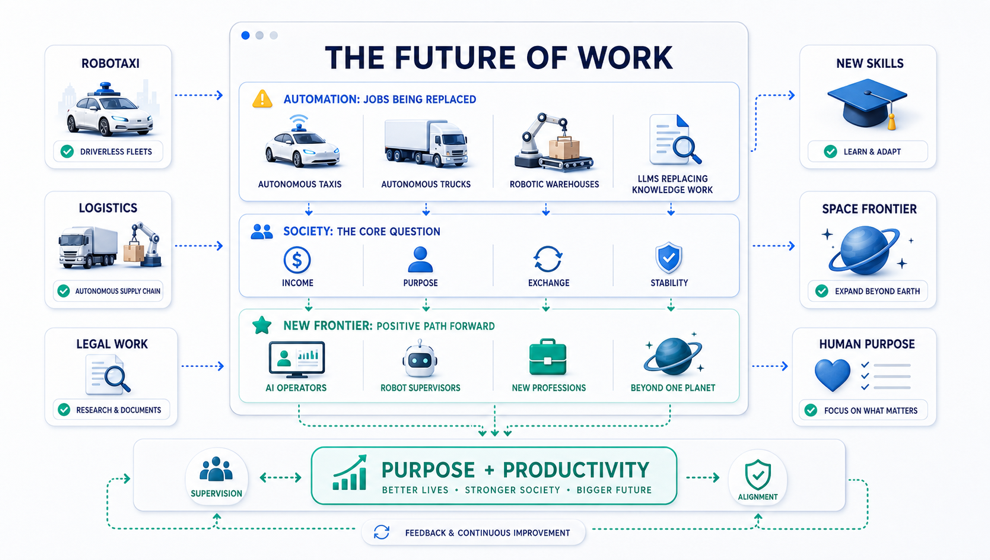
With this longread, I want to share my view not only on the development of AI technologies, but on their impact on society. More precisely, I want to ask a few questions about the future that is coming.
Today, we already have fully autonomous taxis that can move people around cities. Waymo, Alphabet’s autonomous ride-hailing service, has been operating driverless rides for years, and its own safety impact data reports large reductions in bodily injury and property damage claims compared with human-driver benchmarks.
Of course, we still sometimes see funny posts online about a self-driving car getting confused and doing something strange. But if we compare these incidents proportionally with the number of incidents caused by human drivers, it is hard to deny that autonomous driving is already showing serious safety progress.
So we should ask a much bigger question: what does this mean for the transportation industry?
In the United States alone, driving is not a small category of work. The U.S. Bureau of Labor Statistics lists more than 2.2 million heavy and tractor-trailer truck driver jobs, and that does not include all taxi drivers, delivery drivers, couriers, postal drivers, and other transport-related roles.
What prevents corporations from reducing the cost of millions of driver salaries and automating transportation today?
For successful companies, I would say: not much in principle.
Yes, there will be unions. There will be regulations. There will be new technical problems. But these are not strong arguments against the enormous payroll costs that large corporations carry.
And this is only about drivers.
Imagine a slightly broader system. Instead of a human driver, a robot drives a truck. Now the truck does not need to drive only ten hours per day. It can move almost around the clock, stopping only for fuel, charging, maintenance, and warehouse operations. Freight capacity can increase dramatically.
The truck can drive itself to a station, where another robot refuels or charges it. Then it can arrive at an Amazon warehouse, where a third robot unloads the cargo.
Standardizing loading and unloading guides is not a science-fiction-level problem. It is a solvable engineering task.
And at that point, we see that not only drivers are under pressure, but also loaders, warehouse workers, and many other service specialists whose work can already begin to be replaced by robots.
Now let’s look at a completely different field.
Lawyers, attorneys, writers, analysts, and many other knowledge-work professions are also exposed. LLMs are especially strong when the job is to move through a large database or knowledge base and find the relevant parts of documents according to a defined set of criteria.
The more I try to understand which profession is truly irreplaceable by AI, the more I struggle to find one.
So far, the best candidate I have found is a lighthouse keeper in the middle of the ocean. 🙂
If we look at this problem from a macroeconomic point of view, we need to consider both a negative and a supposedly positive scenario. I will say in advance that both look deeply problematic to me.
Let’s start with the obviously negative one.
Corporations replace people with AI-powered robots. They continue to perform their tasks, but the broader economy does not grow enough to absorb the displaced population. People who lose their jobs receive benefits from corporations or from the state, and these benefits are sufficient for a good life. I mean a genuinely good life, not worse than the life they could have built while working for the same companies.
What do we get in this case?
We get riots. Protests. Dissatisfaction. Human resistance. Attempts by the state to somehow manage the conflict. And eventually, a hardening of the political regime in order to protect businesses and infrastructure.
Then either people begin fighting the robots, seeing them as the source of their problems, or we see a serious decline in population because society fails to provide people with a coherent way to live.
The second scenario is the one that looks positive at first.
What if replacing people with robots and AI really does grow the economy?
Corporations grow. They make money. People receive benefits. For a while, this may look like paradise on Earth. But I do not think it will last very long.
A person remains psychologically healthy only while they are in some form of exchange with the surrounding world. In simple terms, people need to give roughly as much as they receive.
After years of living well on benefits while doing nothing useful for the state, for companies, or for the communities they once served, we will again see riots and protests.
But these protests will no longer be only about survival. They will be about mental health, meaning, and the need to feel necessary.
People who are not allowed to participate in equal exchange with society will begin to suffer. It will be similar to children whose parents provide them with everything but do not even allow them to help around the house. Over time, adult people in such a system will slowly begin to lose their balance.
We will see complaints that may look strange from the outside. We will see dissatisfaction. We will see growing conflicts.
People will feel that something is wrong with them, but they may not understand what exactly is wrong. And they will blame those who took away their jobs.
We will see resistance against robots and drones. People will mistakenly believe that the robots themselves are the enemy, because the robots “took” their work.
Corporations will defend their position, their economy, and their infrastructure. And again we will see stricter rules: either you live according to the rules described to you and receive benefits, or you are isolated from society.
In both scenarios, I do not see a truly positive global outcome for society.
My proposal in this area remains the same: we need to keep people involved in work by creating new professions, teaching them to work with AI and robots, and helping them create new things much faster.
The point is not to preserve manual labor for its own sake. The point is to move people into the role of directing, supervising, designing, and improving the systems that perform manual labor.
But then we will run into another problem.
If productivity grows tens or hundreds of times, one planet may simply become too small for the amount of productive capacity humanity can generate. There may not be enough meaningful work here for billions of people who each have dozens or hundreds of robotic “subordinates.”
And this is where we may eventually face the need to expand beyond Earth.
Other planets may become not only a technological dream, but a social necessity: a way for the same number of people to spread wider, build more, explore more resources, and remain involved in meaningful creation.
This would keep the population engaged. It would help people preserve psychological balance. It would allow them to feel needed by society.
For now, this is the only global path I can see that offers a real answer to the problem of robots and AI replacing the professions we know today.