The Feedback Loop Matters More Than Orchestration
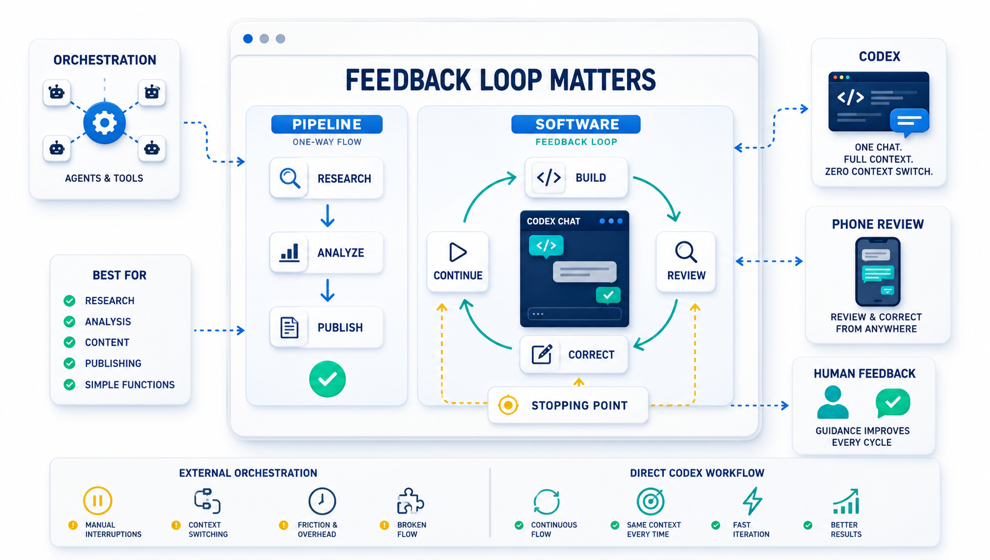
There is a lot of active hype on the internet right now around OpenClaw, Archon, Paperclip, and many other orchestration systems.
At first, I also went deep into this area. It seemed to me that if I configured agent orchestration properly, I would be able to do almost any kind of work from anywhere: from the beach, from bed, or while walking outside.
What I eventually realized is that orchestration through external frameworks depends heavily on the kind of feedback loop the work requires.
If a task can be solved through a mostly one-way pipeline, these systems can be very useful. For example: prepare something, analyze data, create new content, perform a simple function, publish something, or send a prepared result somewhere. In workflows like these, orchestration can automate a lot of work very well.
But when we talk about programming, product creation, or any work where the feedback loop is strong, the situation changes.
Software work is rarely just “start the pipeline and wait.” It is more often:
- Build something.
- Look at what was built.
- Check whether it matches the expected result.
- Compare it with the real behavior.
- Continue from the exact point where the work stopped.
- Or make a correction and run the next cycle.
For this kind of work, many orchestration systems create more friction than convenience.
So where have I landed?
When I am doing marketing research or running relatively simple functions, I can use third-party orchestration. But when I am writing software, I simply use Codex.
This has become even more practical now that Codex lets me open a desktop Codex chat from my phone and add corrections there. If I step away from the computer, I can still open the same technical chat, see what has been done, and, if I have comments, add them directly in that context.
I do not need to stop automatic agents, break a pipeline, or move the work into another system. I can copy the relevant text, paste it into the same chat, add comments, and start the next cycle.
Of course, all of this connects to how detailed the input documents are. Some functions really can be programmed in advance without much feedback, and AI can handle them well.
But whenever correction is required, the time spent stopping an external system, finding the right state, and manually inserting the correction can quickly consume the entire benefit of the automation.
That is why, for me, the key question is not “Can this be orchestrated?”
The better question is: “How tight does the feedback loop need to be?”
If the task is a one-way pipeline, orchestration may be the right tool.
If the task requires constant review, correction, and continuation from the exact same context, a direct Codex workflow is often much more effective.