Should I Give OpenAI and Anthropic Access to My Email and Bank Accounts?
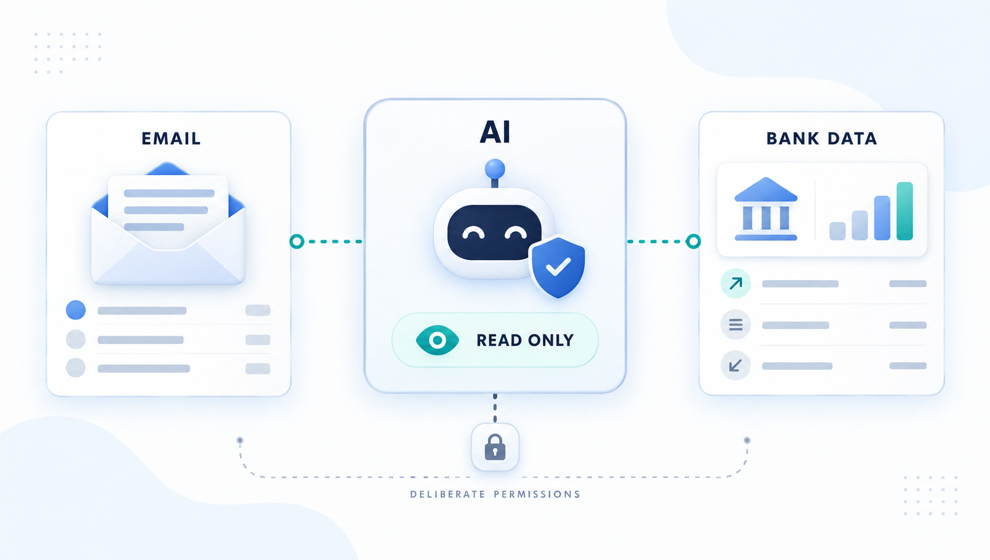
People who care about the security of their data often debate whether they should give ChatGPT or Claude access to their email to help manage it. And what about their bank accounts?
Let’s break the question down. There is no single answer: much depends on whom you already trust with your data, which permissions you grant, and what exactly you are worried about.
Whom Do You Already Trust With Your Email?
Start with a simple question: where is your email stored?
If you use Gmail, it is stored on Google’s servers. Are you comfortable with how securely it is stored? Do you trust the company to process your messages?
Google also has its own AI tools that can work with email and documents through the available features and settings. But we need to distinguish between processing data to carry out your task and using that data to train models. These are different things. For example, Google says that Gemini in Gmail and other Workspace apps does not use their content to train generative models. Source: Google.
If having Google store and process your email is itself unacceptable to you, the question goes beyond connecting ChatGPT or Claude. You would need to reconsider your choice of email service, potentially even running your own server. Let’s set that option aside: it is a separate discussion, and your own server also requires attention to security.
Suppose you are comfortable storing your email with Google. The next question is: what changes when you connect another service?
You add another company to the circle of those you trust to process your data. That means you should assess its terms, how the connection works, and the scope of access.
Data Processing, Training, and Security Are Separate Questions
In my view, connecting OpenAI or Anthropic should not automatically be seen as reckless. But I would not assume that every large company has the same level of security simply because of its size, either.
It is more useful to look at the specific situation:
- What data will the service receive?
- Will it only be able to read the data, or also take actions?
- How long will it keep the data?
- Can it use the data to train models?
- How can you revoke access?
Training policies differ, too. At OpenAI, the use of data from connected apps depends, among other things, on your plan and the “Improve the model for everyone” setting. Anthropic separately states that it does not train models on data from its Gmail, Drive, and Calendar connectors, while outlining conditions for content brought into a conversation through copy and paste or Claude’s responses. OpenAI, Anthropic.
So “should I give AI access?” is too broad a question. What matters is which service gets access, to what data, and under which conditions.
Your Email Client Is Part of This Chain, Too
Now consider how you normally read your email.
If you have connected Gmail to the standard Mail app on your iPhone or to a third-party email client, additional software already processes your messages. In some cases, the app developer’s servers are involved in that processing as well.
Suppose you install a third-party email client. When a new message arrives, the app’s server sends you a push notification containing the sender’s name, the subject, and an excerpt from the message. That means the app provider’s server has access to that data: it cannot send you text it has not received itself.
You are therefore already trusting another company with the contents of your correspondence. How much do you trust it? How securely does it process and store your data?
The same question arises here as with AI: how much do you trust this company, and which permissions do you give it?
Banking Data: Privacy and the Security of Your Money
With bank accounts, it helps to separate two concerns:
First, someone might learn your account balance, income, and spending.
Second, someone might be able to steal your money.
These are different risks, and the measures to address them differ as well.
Your bank already holds your financial information. Depending on the country and the services you use, some of that information may be shared with other organizations. Secure banking therefore does not mean complete anonymity.
But that does not make giving another company access insignificant. Every additional recipient of your data expands the circle of trust.
If you want to use AI to analyze your finances, it makes sense to consider connections with read-only access: retrieving balances and transaction history, compiling statistics, and analyzing spending.
For example, when connecting through a service such as Plaid, you need to examine the specific integration and the permissions it requests. The service’s name alone does not guarantee read-only access: Plaid also offers separate products for transfers. Source: Plaid.
With genuinely restricted read-only access, AI can analyze the available information but will not gain permission to make transfers through that connection. The risk of disclosing financial data remains, however.
Decide Based on What You Are Worried About
Take any other area of your life and ask yourself the same question: what exactly are you trying to protect against?
Your information being used for training? Personal data being disclosed? Losing data? Actions a service could take on your behalf?
It is unhelpful to bundle these concerns into a general “I don’t trust AI.” For each one, you need to look separately at the service’s terms and the permissions granted through the connection.
I would also weigh the benefits. How much more efficiently could you work with email, documents, or financial information with AI’s help? Does that benefit justify giving it additional access to your data?
For some, the answer will be no. For others, it will be yes, with clear terms and limited permissions.
The choice is yours. What matters is understanding exactly what you are allowing and which risks you are willing to accept.