An Important Barrier to Learning: Antagonism
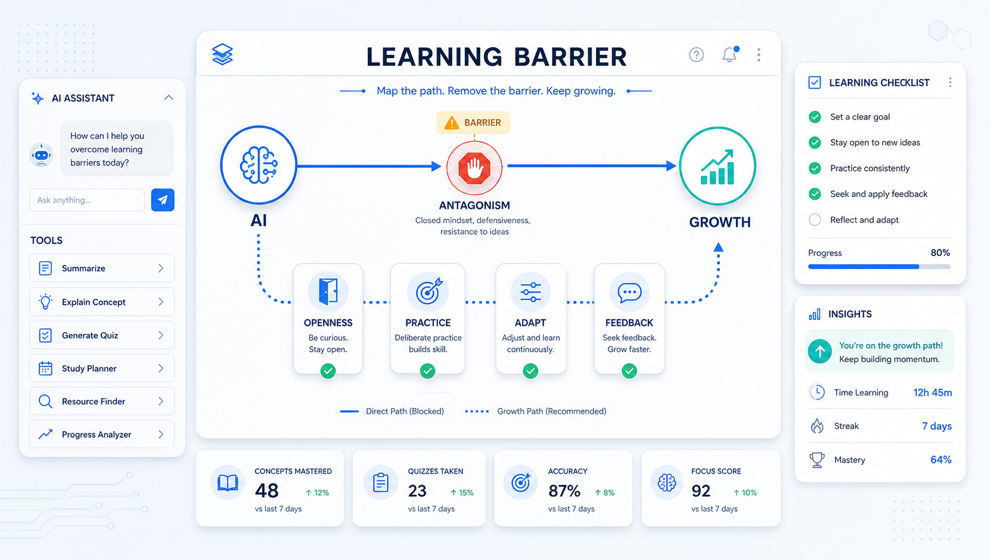
Some time ago, I started writing actively about AI on social media.
This topic works almost like politics. It does not leave people neutral.
Some people are fully in. Others are categorically against it.
I also watch people I work with across different projects. Some of them had a hard time. They complained, struggled, and suffered through the process. But they still tried to learn AI. And they really did speed up their work several times.
But there are also people for whom even looking at the situation and accepting one simple point is painful:
It is time to change.
What Antagonism Looks Like
Let’s look at an emotional state called antagonism.
In this state, a person does not act very effectively. They oppose everything that does not fit their worldview, their habits, or their current point of view.
This matters because there is a difference between two things:
- A strong professional position.
- Antagonism toward something new.
When a person is a professional in a field, or when they have a real visionary view, a stable point of view can help them break through barriers and reach a goal.
That is not the problem.
The problem begins when a person is not a professional in a specific area but still aggressively rejects new ideas, new tools, or new technologies.
That is antagonism.
I Have Paid for This Myself
I can say honestly: in my own life, I have missed huge opportunities more than two dozen times.
In business and in personal life.
Why?
Because I showed antagonism. I was not open to the opportunities life was giving me.
At the time, it probably felt like I was being rational. Or cautious. Or principled.
But in many cases, I was simply closed.
Why This Matters With AI
The same thing is happening with artificial intelligence.
If a person is open to learning:
- How AI works.
- What is new in technology.
- How to apply it today.
- What changed since yesterday.
- Which old methods no longer work.
Then this person has a much better chance of being successful.
Because AI is not a field where you learn one fixed method and use it for the next ten years.
Tomorrow there will be new tools, new workflows, new models, new interfaces, and new ways to work. A person will need to spend part of their time learning again, not only applying what they already know.
That is uncomfortable.
But it is also the current reality.
The Risk of Looking Away
A person who locks into the idea that AI is too scary to even look at may still have some success for a while.
But I do not think such people will be able to preserve their profession for long.
There will be exceptions:
- State licensing.
- Regulated professions.
- Old institutional rules.
- Environments where change is artificially slowed down.
These things can protect some people for some time.
But they will not protect everyone.
And they will not protect every profession.
Why I Am Sharing This
I am sharing this point because I want each person to look at their own area of life:
- Work.
- Education.
- Business.
- Family.
- Personal productivity.
- Professional growth.
Artificial intelligence allows us to dive into the endless world of information with new force and start extracting exactly what we need from it.
Not everything.
Not noise.
Not random content.
Exactly what helps us move forward.
Be Careful With the Inner Refusal
Antagonism often turns on quietly.
It says:
This is nonsense.
Better not waste time on it.
I already know enough.
This will not affect me.
People are exaggerating again.
That voice can feel reasonable. It can even feel like self-protection.
But it can also play a bad joke on us.
Be careful.