Why the Fight Against VPNs Will Be Lost
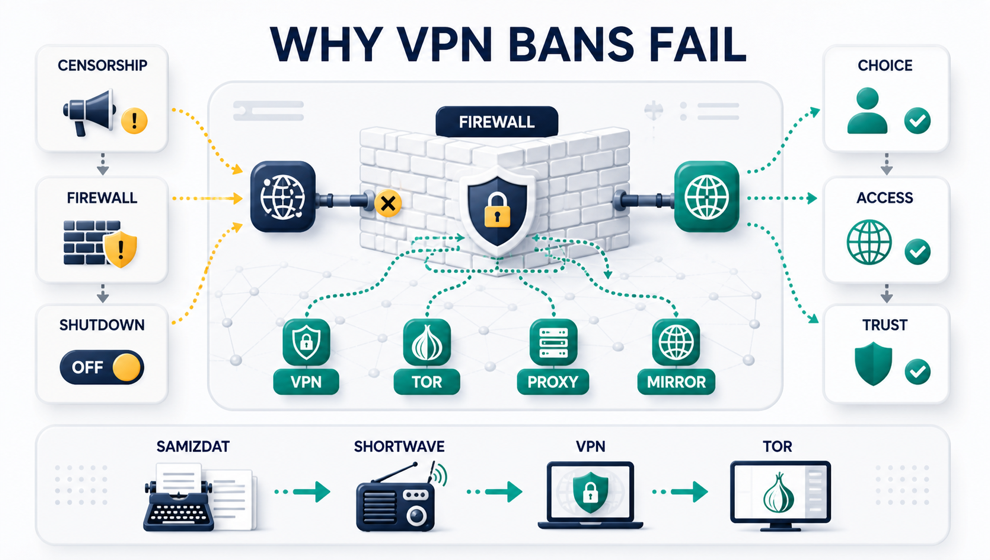
Over the last 200 years, totalitarian and authoritarian regimes have often climbed the same ladder: first they declare an emergency threat, then they restrict “dangerous” media, then they take control of the infrastructure through which information spreads, and eventually they criminalize ways to bypass that control.
Today, VPNs, Tor, Signal, proxies, and mirror sites play the role once played by digital samizdat, shortwave radio, and illegal border crossings.
The Historical Pattern
1. Threat as Justification
A regime almost never says: “We are banning freedom.” It says: “We are protecting society from enemies, extremism, chaos, and foreign influence.” Britannica describes totalitarianism as a system in which all resources are subordinated to a “higher goal,” persecuted groups are tied to an external enemy, and the unpredictability of police action becomes part of social control.
2. Control Over Intermediaries
In fascist Italy, Mussolini not only suppressed the opposition but also created OVRA, a network of political police. Britannica writes about the Fascist Party that the press was tightly censored, newsreels became state propaganda, and radio was controlled by the regime.
In Nazi Germany, the public book burnings of 1933 became a symbol of the destruction of unwanted ideas. The United States Holocaust Memorial Museum writes that these actions targeted books declared “un-German,” including works by Jewish, liberal, and left-wing authors.
3. Control Over Movement
In the USSR, internal passports and propiska, introduced in 1932, were used to register, filter, and restrict the movement of “socially undesirable” people. A study in Cahiers du Monde russe / Cairn describes the passport system as a tool for monitoring population flows and carrying out “social cleansing” in cities and border zones.
In East Germany, the Berlin Wall became a physical firewall. The National Museum of American Diplomacy describes how the wall gradually evolved from barbed wire into a system of parallel walls, a “death strip,” and watchtowers with armed guards.
4. The Rise of Bypass Networks
In the USSR, samizdat was secretly copied and distributed despite the KGB. Britannica writes about samizdat as literature secretly written, copied, and distributed in the Soviet Union, often critical of Soviet power.
Banning information did not kill demand. It created an underground infrastructure of trust. The same thing is happening today with VPNs, Tor bridges, Snowflake, private proxies, and home servers.
The Modern Digital Version
Today, states repeat the same scenario, but instead of printing presses, radio, and passports, they attack internet infrastructure.
Russia
Human Rights Watch writes that Russian laws since 2017 have expanded state control over internet infrastructure and online activity. The “sovereign internet” law requires providers to install DPI equipment that can monitor, filter, and redirect traffic.
Freedom House’s 2025 Russia report says internet freedom in Russia has reached a new low, while the authorities have intensified efforts to isolate the population from the global internet.
China
Freedom House’s China report says the authorities continue to use the national Great Firewall, regional blocking systems, and mass removal of sensitive content.
Iran
Freedom House’s Iran report describes Iran’s online environment as one of the most repressive in the world, marked by censorship, surveillance, content manipulation, and extrajudicial pressure on users.
Myanmar
Associated Press writes that Myanmar’s military junta adopted a cybersecurity law with broad powers to control information, including user-data retention, platform blocking, penalties for VPN services without state permission, and blocks on Facebook, Instagram, X, WhatsApp, and VPN services.
The Global Trend
Freedom House and the European University Institute write in the Tunnel Vision report that over the last five years, anti-censorship technologies, including VPNs, were blocked in at least 21 of the 72 countries studied by Freedom on the Net.
Access Now writes that in 2024, governments around the world imposed at least 296 internet shutdowns in 54 countries.
The Main Analogy
The Berlin Wall was built not because the West was weak, but because the East feared the choices of its own citizens.
The Great Firewall, VPN blocks, and “sovereign internet” projects are built on the same logic: not because free information is low-quality, but because it is competitive.
Why the War Against VPNs Will Be Strategically Lost
1. VPNs Are Not Only Political Tools. They Are Basic Economic Infrastructure.
A full VPN ban breaks corporate access, remote work, banking systems, cybersecurity, and cloud services. That is why regimes are forced to leave “approved” tunnels in place. And every approved opening becomes a model for bypassing control.
2. Bans Increase Demand
After Facebook and Instagram were blocked in Russia in 2022, demand for VPNs surged. Reuters, citing Top10VPN, reported that on the eve of the Instagram block, VPN demand was 2,088% above the normal daily level.
In Iran, during the 2022 protests, Tor observed a similar rise in circumvention tools: the number of Tor bridge users sharply increased in the last week of September 2022.
3. Technology Adapts Faster Than Bureaucracy
Block VPN websites, and mirrors appear. Block protocols, and obfuscation and pluggable transports appear. Block Tor, and people use bridges and Snowflake.
EFF explains that Snowflake allows ordinary users around the world to run temporary proxies and help people in censored countries reach the open internet.
4. The Harsher the Ban, the Higher the Cost for the Regime
The Internet Society writes that internet shutdowns harm economic growth, reduce trust in infrastructure, disrupt business, emergency services, and communication during crises.
In other words, a state can temporarily “defeat” a citizen, but it pays for that victory with the degradation of its own digital economy.
5. Historically, Walls Buy Time but Lose Meaning
Samizdat did not defeat Soviet censorship in one day, but it outlived the system that tried to destroy it.
The Berlin Wall also stood for decades. But in the end, it became not a symbol of East Germany’s strength, but a symbol of the government’s fear of its own citizens.
Conclusion
The global fight against VPNs will be lost not because every VPN is technically impossible to block. Individual services can be blocked. People can be fined. App stores can be pressured into removing applications.
But it is impossible to permanently ban the human need to compare, verify, and speak without surveillance.
A VPN is not just an app. It is a symptom.
If citizens need a VPN, the state has already lost their trust. And when a state starts fighting circumvention tools, it admits that its main opponent is not a foreign website, not a messenger, and not an encryption protocol.
Its main opponent is the independent choice of the individual.